A More Precise Approach to Facial Rejuvenation

Fellowship-trained plastic surgeon Dr. David Hill is the Medical Director of Fulcrum Aesthetics and a member of the American College of Surgeons. His work is built on a simple belief: the best result looks entirely like you, only fresher and better-defined. For patients exploring surgery for early to moderate facial aging, the Ponytail Facelift™ is one of the surgical options he offers.

The Ponytail Facelift™ is a technique developed by Dr. Chia Chi Kao. Dr. Hill is trained in it through the Ponytail Academy and offers it as part of a full range of facial surgery. Schedule a consultation to find out whether it's the right approach for you.

blonde woman looking into mirror

What Is a Ponytail Facelift™?

The Ponytail Facelift™ is a minimally invasive, endoscopic procedure that lifts and repositions the deeper layers of facial tissue through small incisions hidden within the hairline. Instead of the long incisions and skin removal of a traditional facelift, the surgeon works with an endoscope (a thin, lighted tube with a miniature camera) to see and reposition the underlying structures without taking skin away.

The name comes from the lifted, refreshed look you get when you pull your hair into a high ponytail. Here, that effect is achieved through incisions placed high in the hairline and a vertical lift, which avoids the sideways, windswept appearance that horizontal techniques can create. Repositioned tissue is held with absorbable sutures or small absorbable fixation devices, and the incisions stay concealed in the scalp.


textured background

Ponytail Lift™ vs. Ponytail Facelift™ — What's the Difference?

These two terms describe related but different scopes, and knowing which one you need matters:

  • Ponytail Lift™ addresses the upper and mid face (brow, cheeks, midface, and jawline) through small incisions hidden entirely within the hairline. No incisions in front of the ears, and no skin is removed.
  • Ponytail Facelift™ is the Ponytail Lift™ plus a limited-incision neck lift, for patients who also need the neck and jawline tightened. The neck portion uses two additional, discreet incisions — a short incision under the chin and another just behind the ears — which remain well-hidden but are part of treating the neck.

At your consultation, Dr. Hill will tell you which scope fits your anatomy. Many patients need only the lift; others get a more complete result when the neck is addressed at the same time.

Banner media

How This Differs From a Traditional or Deep Plane Facelift

An endoscopic facelift, broadly, repositions facial tissue through small camera-assisted incisions rather than the long incisions and wide skin undermining of an open facelift. Compared with a traditional approach, the Ponytail Facelift™ offers:

  • Smaller incisions and far less tissue disruption
  • A vertical lift direction that avoids the pulled or windswept look
  • Incisions hidden in the hairline, so you can wear your hair up without visible marks
  • Generally less bruising and swelling during recovery
  • Precise targeting of the brow, cheeks, and midface
  • A natural result, because the technique repositions your own tissue rather than stretching skin

Because the procedure does not remove excess skin, patients with significant skin laxity are often better served by a traditional or deep plane facelift. Dr. Hill will be straight with you about which one will actually give you the result you want.

eoman getting a consultation

Am I a Good Candidate?

This technique tends to work well for patients in their 30s, 40s, or early 50s who are starting to notice sagging in the cheeks or midface, heaviness along the brow, softening of the jawline, or deepening lines between the nose and mouth and who still have reasonably good skin elasticity. If you have more advanced skin laxity, a deep plane facelift may serve you better, and Dr. Hill will tell you so.

textured background

What to Expect During Your Procedure

Preparation and anesthesia 

The procedure is performed under general anesthesia or IV sedation, depending on your medical profile and the scope of treatment. Once you're comfortable, the surgical team prepares the incision sites within your hairline.

The lift 

Through several small incisions hidden in the scalp, Dr. Hill introduces the endoscope and specialized instruments. Using the camera feed, he lifts and repositions the deeper facial tissue, elevating the cheeks, softening the lines around the nose and mouth, and restoring the brow to a more youthful position. No incisions are made in front of the ears, and no skin is removed.

The neck, when included 

For a full Ponytail Facelift™, Dr. Hill adds a limited-incision neck lift to address banding and looseness, using a small number of additional discreet incisions that stay well-concealed.

Fixation and closure 

Repositioned tissue is secured with absorbable sutures or small fixation devices that dissolve over time, and the incisions are closed.

Background media

What Your Results Will Look Like

Results become visible as swelling resolves, usually within a few weeks, and continue to refine over several months. Patients generally see a more lifted, well-rested appearance with improved cheek and midface contour. How long results last depends on your skin quality, age, and lifestyle. For the right candidate, outcomes can hold for many years.

What to Expect During Recovery

Most patients have mild to moderate swelling and bruising in the first week, which settles gradually. Many feel comfortable returning to desk work and light activity within one to two weeks. Exercise and strenuous activity are typically restricted for three to four weeks. Dr. Hill and the Fulcrum team provide detailed aftercare guidance and stay accessible throughout your recovery.

Banner media

Why Patients Choose Dr. Hill

Dr. Hill's approach to aesthetic surgery is guided by a deep respect for anatomy and a commitment to results that look effortless. 

His fellowship training at Rush University Medical Center, combined with ongoing collaboration with leading aesthetic surgeons and his training through the Ponytail Academy, keeps his technique current and precise. Endoscopic work demands accuracy (the surgeon operates through small incisions with camera assistance) and that detail-driven precision shows in his results.

Related and Complementary Procedures

Patients considering or combining the Ponytail Facelift™ with other treatments often explore:

  • Deep plane facelift — a more comprehensive option for significant facial and neck laxity that removes skin.
  • Neck lift — removes excess neck skin and tightens the underlying muscles for a cleaner jawline and neck profile.
  • Brow lift — raises the forehead and brow to address heaviness or hooding above the eyes.
  • Blepharoplasty — corrects excess skin and puffiness of the upper and lower eyelids for a more alert, refreshed look.
  • Facial fat grafting — uses your own fat to restore lost volume in the cheeks, temples, and under-eyes, often performed alongside lifting.
  • Platysmaplasty — tightens the neck muscles to address banding and looseness for a smoother neck contour.
Banner media

How Much Does It Cost?

Cost varies with the scope of your procedure, anesthesia, and facility fees. Because this is a customized surgical procedure, pricing is determined after your consultation. Financing options are available, and the team will walk you through them.

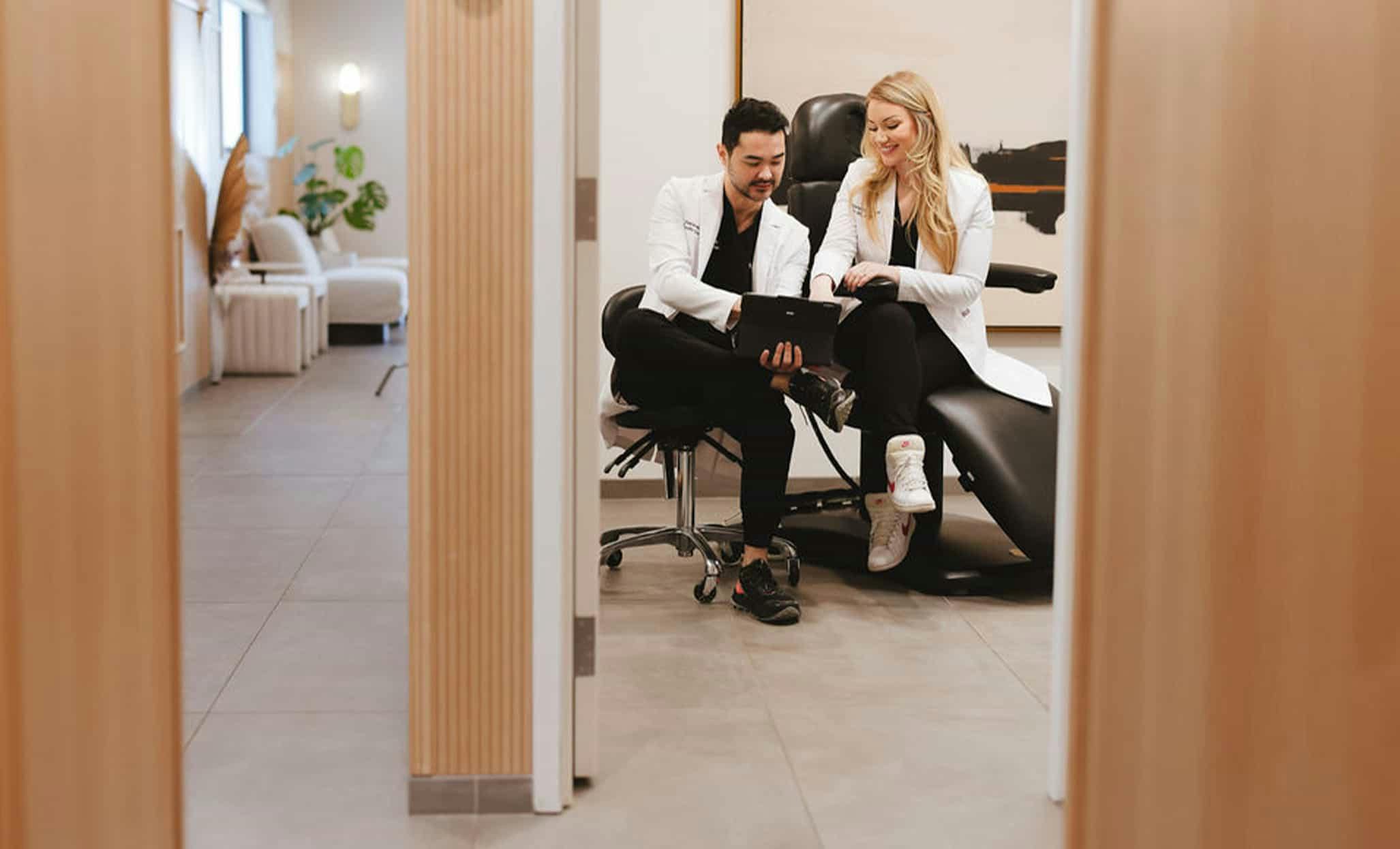
Dr. David Hill and Brittony Croasdell

Your Consultation

At your consultation, Dr. Hill will take the time to understand your concerns and what you're hoping to achieve. He'll assess your facial anatomy, skin quality, and the degree of tissue change to determine whether a Ponytail Lift™, a full Ponytail Facelift™, or a different procedure entirely is the right fit. 

You'll leave with a clear, honest picture of what's realistic and what the process involves. No pressure, no sales pitch.

textured background

Ready to Take the Next Step?

A more refreshed, more defined version of your face is possible, and it doesn't have to look like anything other than you. At Fulcrum Aesthetics in Chicago, Dr. Hill will give you an honest read on what's achievable and what the process actually involves. Schedule a private consultation to find out whether a Ponytail Facelift™ is right for you.

Ponytail Lift™ and Ponytail Facelift™ are trademarks of their owner and are used by Dr. Hill as a provider trained through the Ponytail Academy.

Banner media

FAQs

Can this be combined with non-surgical treatments?

What is an absorbable fixation device, and is it safe?

How long will the results last?

How is this different from non-surgical treatments like Morpheus8 or Sculptra?

Is general anesthesia required?

Can men be good candidates?

What should I ask during my consultation?

Can this be combined with non-surgical treatments?

In some cases, yes. Treatments like Morpheus8, fat grafting, or injectable fillers can be performed alongside or shortly after surgery, depending on your plan. Dr. Hill will advise on timing and sequencing at your consultation.

What is an absorbable fixation device, and is it safe?

Small absorbable devices (such as ENDOTINE implants) are sometimes used to hold repositioned tissue in place while it heals. They are FDA-cleared and dissolve on their own once healing is complete.

How long will the results last?

For well-suited candidates, results can last five to ten years or longer, depending on skin quality, lifestyle, and how your face continues to age. The procedure doesn't stop aging—it gives you a better starting point.

How is this different from non-surgical treatments like Morpheus8 or Sculptra?

Non-surgical treatments can tighten skin, stimulate collagen, and add volume, but they can't physically lift and reposition facial tissue the way surgery can. For true sagging or structural change, no injectable or device-based treatment produces an equivalent result. The right choice depends on where you are in the aging process.

Is general anesthesia required?

Not always. The procedure can be done under general anesthesia or IV sedation depending on your medical profile and scope. Dr. Hill will discuss the best option at your consultation.

Can men be good candidates?

Yes. The endoscopic approach suits male patients well, and the hairline-hidden incisions address a common concern for men who want to avoid visible scarring near the ears.

What should I ask during my consultation?

Ask about the surgeon's specific experience with the endoscopic technique, how the repositioned tissue is secured, and what's realistic for your anatomy. A surgeon who agrees with everything you want without any pushback is telling you something important.

New Patient Special! ‍10% OFF Your First Non-Surgical Treatment

This field is required.
Submit
Accessibility: If you are vision-impaired or have some other impairment covered by the Americans with Disabilities Act or a similar law, and you wish to discuss potential accommodations related to using this website, please contact our Accessibility Manager at 773-799-8664.
Contact Us