

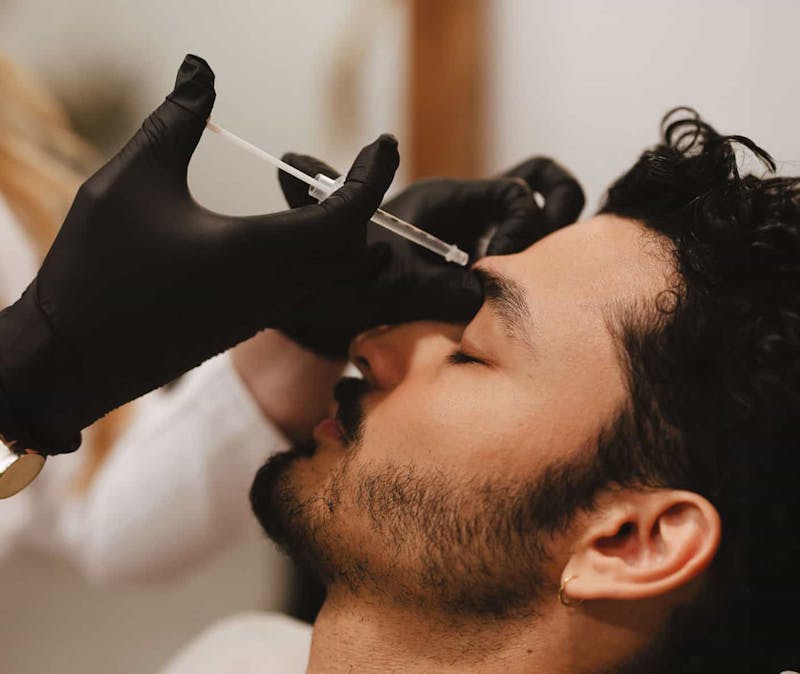
Choosing between BOTOX, dermal fillers, and a facelift depends on your individual facial anatomy and its needs. BOTOX and fillers are highly effective for early to moderate signs of aging, as they help soften expression lines and restore lost volume. However, these treatments do not reposition deeper tissues or correct significant skin laxity. In contrast, a facelift is specifically designed to address more profound facial sagging and structural changes that non-surgical treatments cannot fully resolve.
At Fulcrum Aesthetics, this distinction is central to our approach to treatment planning. Our practice is led by Dr. David A. Hill, a fellowship-trained plastic surgeon, and Brittony Croasdell, MS, FNP-BC, APRN, CANS, an internationally recognized injector and educator. Because we specialize in both surgical and non-surgical facial rejuvenation, we can evaluate the face comprehensively—beyond isolated concerns to understand how structure, volume, and movement interact over time.
In this article, we’ll outline what each approach can realistically achieve, where its limitations begin, and how to determine when surgery becomes the more appropriate and effective option.
The Real Difference Between Injectables and Surgery
Over time, skin becomes less elastic and thinner, and age-related changes in collagen and elastin contribute to wrinkling and laxity, as explained by the National Institute on Aging. That is why the face can begin to look heavier, flatter, or less defined even when the skin itself is still in relatively good condition.
What BOTOX does best
BOTOX is an FDA-approved botulinum toxin product used to temporarily reduce muscle activity that contributes to dynamic lines, which are created by repeated facial movement. This makes it most useful for concerns such as:
- forehead lines
- frown lines
- crow’s feet
- other expression-related wrinkles
However, it does not restore lost volume or lift sagging tissue.
What fillers do best
Dermal fillers are designed to create a smoother or fuller appearance in areas such as the cheeks, lips, chin, and nasolabial folds.
The FDA’s guide to approved dermal fillers also explains that certain hyaluronic acid fillers generally last about 6 to 12 months, depending on the product and indication.
Fillers are often a strong option when the goal is to:
- restore volume in the cheeks or under-eyes
- refine lips, chin, or jawline
- soften moderate folds
- improve contour without surgery
When used effectively, fillers can appear elegant and subtle. However, when used to address structural sagging, they may begin to serve a function for which they were not originally intended.
When Surgery Becomes the More Effective Option
A facelift becomes a more appropriate consideration when you notice:
- Softening or loss of definition along the jawline
- Jowls that blur the transition between the face and neck
- Deeper nasolabial folds driven by tissue descent, not just volume loss
- Laxity or excess skin in the lower face and neck
- Flattening through the midface, where the cheeks appear less supported
- The sense that filler is being used more frequently, with less meaningful improvement
At this stage, the goal is no longer to simply smooth or fill. It becomes about restoring the underlying framework of the face; a facelift is designed to do exactly that. By lifting and repositioning deeper facial structures, it can:
- Reestablish a more defined jawline
- Elevate the cheeks and midface
- Soften deeper folds by correcting their cause, not just their appearance
- Tighten and refine the neck
- Restore overall facial balance and proportion
Rather than adding volume to compensate for descent, surgery allows for a more precise, anatomical reset while preserving natural expression.
Upfront Cost vs. Long-Term Value
Patients often compare surgery with injectables based on immediate cost alone, but that can be misleading:
- The ASPS 2024 Plastic Surgery Statistics Report shows that botulinum toxin and soft tissue fillers remain among the most commonly performed minimally invasive aesthetic procedures in the United States
- That popularity reflects how effective and accessible these treatments can be
- But it also means many patients continue to reinvest in maintenance over and over again
If you are using repeated filler and BOTOX appointments to chase a result that still does not fully address your lower face or neck, the better value may eventually be surgery
A facelift has a higher upfront cost, but it can provide a more decisive correction for the right anatomy and goals.
Why the Best Answer Is Often Not Either/Or
Fulcrum Aesthetics believes that facial rejuvenation should not be viewed as a choice between surgery and non-surgical treatments. The best outcomes often come from understanding which approach is most suitable for each individual.
A patient may benefit from:
- Surgery to restore facial support and contour
- BOTOX to soften dynamic lines
- Fillers to strategically enhance volume
- Skin treatments to improve tone, texture, and surface quality
Natural-looking results are achieved not by relying too heavily on one method, but by intentionally balancing structure, movement, volume, and skin quality.
If you are beginning to wonder if injectables alone are sufficient for your needs, this may be the perfect time for a more comprehensive evaluation. Schedule a consultation with Fulcrum Aesthetics today to determine the best option for you.